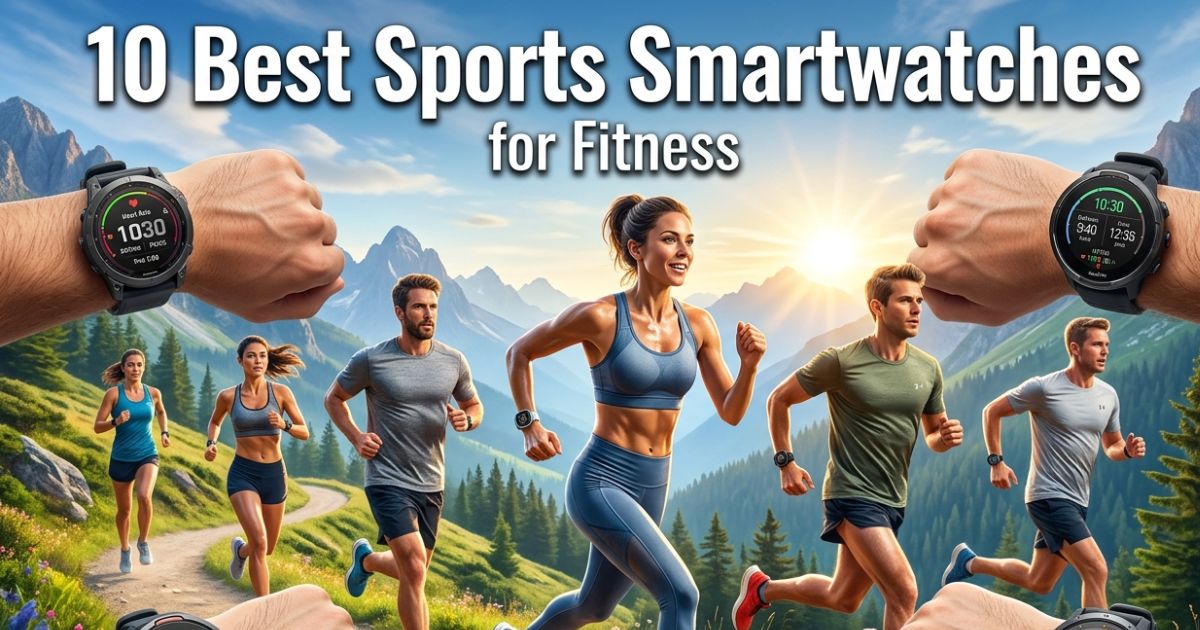

Sports smartwatches for fitness are wearable devices built to log every mile, rep and calorie burned during your workouts. Today’s best fitness watches do far more than count steps. They monitor heart rate and sleep, guide structured workouts, store music, and keep you on course with built-in GPS. In this guide, we review the 10 best sports smartwatches for fitness – from running-focused GPS watches to rugged, waterproof multisport trackers. You’ll find clear pros/cons, key features, and expert tips to choose the right model for your needs, whether you’re a marathon runner, triathlete, or weekend gym warrior.
Why Use a Sports Smartwatch?
A sports smartwatch goes beyond a standard fitness tracker by providing comprehensive workout data and durability. It automatically tracks activities (running, cycling, swimming, etc.) and switches between sports modes seamlessly. These watches often include advanced sensors (GPS, optical heart rate, barometer, etc.) to deliver accurate pace, distance, elevation and heart-rate data in real time. For example, the Garmin Fenix 8 is built to “withstand the knocks and scrapes of wilder adventures with premium materials like toughened sapphire glass and a titanium/DLC bezel”, while the Apple Watch Ultra 3 and Samsung Galaxy Watch Ultra offer high water resistance (100m/10ATM) for serious swimming or diving. In short, a sports smartwatch is the ultimate training partner: it tracks your workouts automatically, provides workout plans and recovery advice, and endures harsh conditions, so you can focus on getting fit.
Key benefits include:
- Built-in GPS: High-end sports watches use multi-band or dual-frequency GPS to nail running routes and paces. For example, the Suunto Race S Titanium and Garmin Forerunner models use dual-frequency GNSS for pinpoint accuracy.
- Heart-Rate Tracking: Nearly all sports smartwatches include continuous heart-rate monitors. Some (like the Polar Vantage M3) even add an ECG sensor and SpO₂ for extra data. In tests, Garmin and Samsung trackers deliver “reliable GPS and heart rate accuracy” during training.
- Waterproofing: If you swim or sweat hard, a waterproof sports watch is essential. Many top models start at 5ATM (50m) water resistance, with premium options rated 10ATM (100m) or more. The Apple Watch Ultra 3 is water-rated to 100m, and the Galaxy Watch Ultra offers 10ATM protection – making them true waterproof fitness watches.
- Durability: A durable sports smartwatch uses rugged materials (sapphire, titanium, reinforced plastics) and shock-resistant design. Garmin’s Fenix 8 and Suunto’s titanium models exemplify this—built to survive falls and extreme environments. Budget-friendly models like the Amazfit Active 2 also offer decent toughness for the price.
Choosing the right sports smartwatch depends on your activities and priorities: GPS runners may favor a Garmin Forerunner or Suunto, while triathletes might choose a Garmin Fenix or Apple Watch Ultra for multisport tracking. The sections below cover the top 10 picks, each with standout features, so you can find the best running, waterproof, heart-rate, and overall fitness watch for you.
Key Features to Look For
Before diving into our top picks, here are some key factors when choosing a sports smartwatch:
- GPS Accuracy: For running and outdoor workouts, multi-system or dual-band GPS ensures the best location accuracy. Look for watches labeled with “All Systems” or “Dual Frequency” GPS.
- Water Resistance: Check the watch’s ATM rating. A minimum of 5ATM (50m) is good for pool swimming and showering; 10ATM or specialized dive modes (like on the Apple Ultra) are needed for heavy swimming or snorkeling.
- Battery Life: Longer battery life means more tracking and less charging. Multi-day or multi-week endurance is ideal for adventure workouts. For instance, the COROS Pace Pro offers up to 20 days in smartwatch mode, and the Garmin Fenix 8 can last several days even with heavy GPS use.
- Heart Rate and Health Metrics: Make sure it has an accurate optical HR sensor and any extra health features you want (ECG, SpO₂, sleep tracking). All the watches below have heart-rate monitoring, but accuracy can vary slightly. Third-party reviews praise Garmin and Samsung’s HR accuracy for most activities.
- Multisport Modes: If you cross-train (e.g. running + biking + gym), look for a watch with many sport profiles and easy switching. The Polar Vantage M3, Suunto Race S, and Amazfit Active 2 all offer 90–150+ built-in sports modes.
- Durability & Comfort: A watch should be tough yet comfortable. Titanium, sapphire glass and reinforced bezels (as on Fenix and Suunto) provide durability, while slim models (like the Garmin Venu X1) focus on wearability.
- Connectivity & Extras: Consider smartphone compatibility (iOS or Android), music storage, contactless payments, etc. Note that some sport-focused models (e.g. Coros, Suunto) may have limited smart features, while others (Apple/Samsung/Pixel) act like full smartwatches with apps and notifications.
With these criteria in mind, let’s explore our top-rated sports smartwatches for fitness.
1. Garmin Fenix 8
Overview: The Garmin Fenix 8 tops our list as the ultimate multi-sport fitness smartwatch. It’s built for adventurers and serious athletes. Its rugged design (sapphire-titanium case, DLC bezel) can handle extreme conditions. Key specs include a 51mm AMOLED display, 10ATM water resistance, and dual-frequency GPS. Battery life is excellent (up to 104 hours GPS mode). Garmin’s latest Fenix adds a brighter, bigger screen and even voice assistant capability, while keeping its powerhouse training suite.
- Pros: Outstanding multi-sport tracking (hundreds of activity profiles), very long battery (weeks in smartwatch mode), full navigation (offline maps, ClimbPro), top-notch durability (sapphire glass, titanium), and reliable GPS/heart-rate accuracy.
- Cons: Large case (not ideal for small wrists), and it’s expensive. Its smart features (music, notifications, Garmin Pay) are strong but still less than Apple’s.
Why we like it: The Fenix 8 is “Garmin’s most capable, feature-packed, premium adventure fitness tool”. It literally has every tool a training addict could want, from recovery advisors to multi-band GPS. It even includes a flashlight and now basic voice memos. In testing, reviewers found it “tough, talented, [with] reliable GPS and heart rate accuracy, along with excellent battery life”. For serious outdoors and fitness tracking, this watch is hard to beat.
2. Apple Watch Ultra 3
Overview: Apple’s Ultra 3 is the most rugged sports watch in the Apple lineup. Housed in a 49mm titanium case (sapphire glass), it’s water-resistant to 100m and built for triathlons and adventure. Key upgrades over Ultra 2 include a larger 2.12‑inch retina display (brighter for use in sunlight), a new S10 processor for better on-device coaching, and improved dual-frequency GPS. Battery life reaches about 20–42 hours in heavy use (GPS+HR), with a low-power mode extending it to ~72 hours.
- Pros: Excellent screen (largest on any Apple Watch), very durable (sapphire front, rugged case), good battery for Apple Watch (up to ~42h), built-in GPS/GNSS, and full suite of sensors (heart rate, SpO₂, compass, emergency satellite, etc.).
- Cons: Limited app ecosystem (watchOS) compared to Android alternatives, and still shorter battery than some Garmin/Coros watches. Requires an iPhone for setup.
Why we like it: The Ultra 3 is “Apple’s most capable sports watch yet, aimed squarely at runners, endurance athletes and anyone who wants serious multi-sport tracking”. Its GPS accuracy is top-notch (“now among the best you’ll find on any sports watch”), and it adds nice-to-have features like emergency messaging and sleep/ECG tracking. If you’re an iPhone user who wants both smartwatch apps and true sports performance, the Ultra 3 is the go-to choice.
3. Suunto Race S Titanium
Suunto’s Race S Titanium is a lean, midsize sports watch that “nails the basics on a budget”. With a 45mm titanium bezel (53g), it’s lighter than most high-end trackers. It has a vivid 1.32″ AMOLED screen, 5ATM water resistance, and dual-frequency GPS for accuracy. Battery life is strong: about 9 days in smartwatch mode and up to 120 hours with GPS at lower accuracy.
- Pros: Lightweight yet durable (titanium frame), very accurate GPS and long GPS battery (30–120h), and Suunto’s intuitive tracking app with offline maps and coaching. Good multi-sport support (95 built-in modes, including run/bike/swim).
- Cons: Limited smartwatch features (no offline music, few third-party apps) and the screen is bright but not as bright as some premium watches.
Why we like it: The Race S is “an impressive sports tracker that’s smaller but still mighty”. In use, reviewers loved its bang-for-buck value: it offers core features (dual-GPS, HR, altimeter, recovery tracking) at a midrange price. It’s perfect for someone who wants Garmin/Suunto accuracy in a smaller, everyday wearable. You get all the training and recovery insights (HRV, route guidance, ClimbPro-like elevation guidance) without the bulk or cost of big multisport watches.
4. Polar Vantage M3
The Polar Vantage M3 is a premium sports watch that emphasizes recovery and insights. It has a 1.28″ AMOLED touchscreen, 5ATM water resistance, and dual-frequency GPS. Key sensors include Gen4 optical HR, wrist ECG, skin temperature, and SpO₂—a very rich sensor set. Battery runs ~7 days normally, or 30–70 hours with GPS on.
- Pros: Bright AMOLED display, elite recovery tools (Nightly Recharge sleep/HRV and FitSpark workout suggestions), extensive sports modes (150+ including multisport/training tests), and offline color maps. Very solid GPS and multi-sport tracking accuracy.
- Cons: Polar’s app and UI are a bit clunky, and smart features are minimal (notifications only, no music).
Why we like it: The Vantage M3 is described as a “burnout-busting recovery master”. It’s one of the best Polar watches ever made: it brings an attractive AMOLED screen (a first for M-series), and a sensor-packed design aimed at beating fatigue and overtraining. If you care deeply about tracking recovery (Nightly Recharge) and performance tests (running/cycling tests), the M3 excels. Its accuracy is solid across the board, and the new guidance tools (FuelWise fueling, FitSpark workouts) are unique, making it a top choice for multi-sport enthusiasts on a moderate budget.
5. COROS Pace Pro
COROS is known for ultra-long battery life, and the Pace Pro combines that with an AMOLED display. It’s a lightweight training watch (46×46×12mm, 37g) with 5ATM rating. Its 1.3″ AMOLED screen is bright (1500 nits), and the watch packs dual-frequency GPS, ECG, baro altimeter, and SpO₂ sensors. Impressively, even with the power-hungry display, the Pace Pro lasts up to 20 days in smartwatch mode (and 12–38h with GPS on).
- Pros: Class-leading battery life for an AMOLED sports watch, vibrant high-brightness screen, and comprehensive training features (ECG, advanced running/cycling/swim metrics, VO₂max, etc.). It also supports triathlon mode and offline topo maps.
- Cons: Uses a plastic polymer case (less premium feel), fewer niche sport modes (no climbing or motorsports), and lacks some smartwatch luxuries (no contactless pay, limited music support).
Why we like it: The Pace Pro “is the best option for an AMOLED screen without sacrificing staying power”. In practice it delivers Garmin-like training metrics with massive endurance: reviewers noted “the battery life is impressive for an AMOLED watch, GPS and heart rate on par with rivals”. It even added offline maps. If you want a bright display and a feature-rich fitness platform without daily charging, this watch stands out. (If you don’t care about AMOLED, the COROS Pace 3 offers similar performance for even less cost.)
6. Amazfit Active 2
On a tighter budget, the Amazfit Active 2 packs a surprising amount of gear. It has a 1.32″ AMOLED touchscreen, 5ATM waterproofing, and all-systems GPS (no dual-band). Battery life is about 10 days typical, and ~21 hours with GPS. It supports 164 sport modes (including swimming, strength, even HYROX race mode) and includes an AI coach feature for custom training plans.
- Pros: Extremely affordable, lightweight, and stylish with a stainless-steel bezel. Comprehensive health and fitness features: optical HR, SpO₂, skin temp, altimeter for sleep and readiness scores. Also supports notifications, music control, NFC payments, and Alexa voice assistance – a full smartwatch experience.
- Cons: GPS accuracy is good but not as refined as high-end dual-frequency units. Some advanced features (route navigation, app polish) are less refined than on pricier watches. Strap quality could be better.
Why we like it: The Active 2 is a “cut-price fitness watch that packs plenty of performance for a very wallet-friendly spend”. In use, it delivers the essentials: a vivid 2000‑nit display, a long feature list (heart health, AI coach, 24/7 tracking), and respectable accuracy. The trade-offs are understandable: it isn’t Garmin-level finesse, and some features feel a bit raw, but for under $150 it’s hard to beat for general fitness and even casual sports use. It’s our pick for budget-conscious athletes.
7. Samsung Galaxy Watch Ultra
Samsung’s Galaxy Watch Ultra (47mm) is a rugged Wear OS watch aimed at adventurous Android users. It offers a solid titanium + reinforced design with 10ATM water resistance. The Ultra gives you accurate dual-frequency GNSS for mapping, and extensive health sensors (ECG, SpO₂, BioActive sensor). Battery life averages 2–3 days with heavy use, which is lower than the Garmin’s multi-day endurance but typical for Wear OS. It has advanced sports features like FTP-based training and multisport tracking.
- Pros: Very durable, solid build quality, and a bright 1.4″ AMOLED screen. Excellent HR and GPS tracking in testing, and detailed sleep monitoring. Samsung’s software is user-friendly with a rotating bezel.
- Cons: Bulky size (may overwhelm smaller wrists). Battery life can be inconsistent (Samsung noted it varies). Some advanced features require a Samsung phone (though basic features work with any Android).
Why we like it: The Galaxy Watch Ultra “offers accurate dual-frequency GNSS, all the health tech bells and whistles, [and] 10ATM water resistance”. Reviewers praised its “solid build and fun design” and found HR/GPS tracking excellent. It essentially brings Apple Watch Ultra–style ruggedness to Android, and it’s the only Wear OS watch with this level of toughness. If you want a premium Android-friendly sports watch, this is it.
8. Google Pixel Watch 4
Google’s Pixel Watch 4 is the latest Wear OS watch with deep Fitbit integration. It’s a smaller 41mm watch but packs an AMOLED screen, onboard GPS, heart-rate and ECG sensors, and Google’s new Tensor G3 chip. In early tests, it’s been called “the best all-round Wear OS smartwatch” thanks to upgrades over the Pixel Watch 3. Battery life hovers around 1–1.5 days in real use.
- Pros: Elegant design, fast performance (Wear OS 3.0+), and strong fitness software via Fitbit. It offers 24/7 heart rate, SpO₂, sleep scoring, and auto workout detection.
- Cons: Short battery life (daily charging needed) and still not as feature-rich for sports as dedicated training watches. It excels more as a lifestyle and light-fitness tracker.
Why we like it: The Pixel Watch 4 is recommended as the top Wear OS smartwatch for fitness. If you want a smartwatch that also tracks fitness well, the Pixel offers a smooth experience for Android users (especially Pixel phone owners). Its Fitbit health tracking is comprehensive, and it’s light and comfortable for all-day wear. It’s not as rugged or long-lasting as the others here, but for everyday workouts and urban runners it’s a strong choice.
9. Garmin Venu X1
The Garmin Venu X1 is a sleek, GPS-focused watch designed for style and sports. It has an ultra-thin titanium case (just 7.9mm thick) and a bright AMOLED screen. Under the hood, it’s fully Garmin: advanced training metrics (Training Status, Endurance Score, PacePro, etc.), built-in coach, and offline maps. In testing, its core sports accuracy “is outstanding”, matching higher-end Garmins.
- Pros: Exceptionally light and comfortable (an “ultra-thin marvel”). It covers all the essential fitness features (GPS, HR accuracy) with Garmin’s smooth interface, plus extras like a built-in LED flashlight.
- Cons: Battery life is only about 2 days with Always-On Display, and it’s quite expensive for the battery you get. Also lacks some high-end Garmin features (no dual-band GPS or ECG).
Why we like it: Venu X1 is for the Garmin fan who wants something flashy. In reviews, it “squeezes in Garmin’s full suite of advanced training metrics” while being the thinnest Garmin ever. Its main flaw is battery, but if you charge it nightly it otherwise behaves like a top sports watch with a premium look. We include it here for those who prioritize design without sacrificing true sports tracking.
10. Garmin Forerunner 55
For a value option, the Garmin Forerunner 55 is a straightforward yet very capable running watch. It uses a simple, durable design with a 43mm MIP display, 5ATM rating, and 10-day battery life. It tracks all running essentials (pace, distance, simple maps via connected GPS), provides daily training suggestions, and keeps heart-rate measurements. It doesn’t have music storage or multiband GPS, but it nails the basics at an affordable price.
- Pros: Fast, accurate GPS lock and consistent heart rate monitoring. Battery life easily lasts a week of use. Light and comfortable to wear (good for all-day tracking). Includes Garmin Coach training plans.
- Cons: No onboard maps, no music or payment support, and a basic display (non-touch, monochrome). Fewer advanced metrics than higher-end models.
Why we like it: The Forerunner 55 “proves you don’t need a flagship to get good running data”. Reviewers note it is “proof that practicality and performance can live happily together without emptying your wallet”. It’s perfect for new runners or budget buyers who still want reliable GPS and HR tracking. This pick means even the cheapest model on our list meets the essential criteria of a sports smartwatch: tough design, water resistance, heart-rate monitoring, and multi-day battery.
Conclusion
Choosing the right sports smartwatch for fitness depends on your sport, smartphone, and feature priorities. The Garmin Fenix 8 and Apple Watch Ultra 3 are top-tier do-it-all rugged watches (best for multisport and adventure), while the Suunto Race S and Polar Vantage M3 offer great training insights at midrange prices. The COROS Pace Pro excels in battery life, and Amazfit Active 2 gives budget buyers full fitness features. Android users might prefer the Samsung Ultra or Pixel Watch 4, and Garmin fans have plenty of options from Venu X1 to Forerunner 55.
No matter which you pick, make sure it fits your wrist comfortably, syncs with your preferred apps, and covers the activity modes you need. With any of these sports smartwatches for fitness, you’ll get GPS accuracy, waterproof durability, and heart-rate tracking to power your workouts. Strap it on, start training, and watch your fitness journey come to life.
