
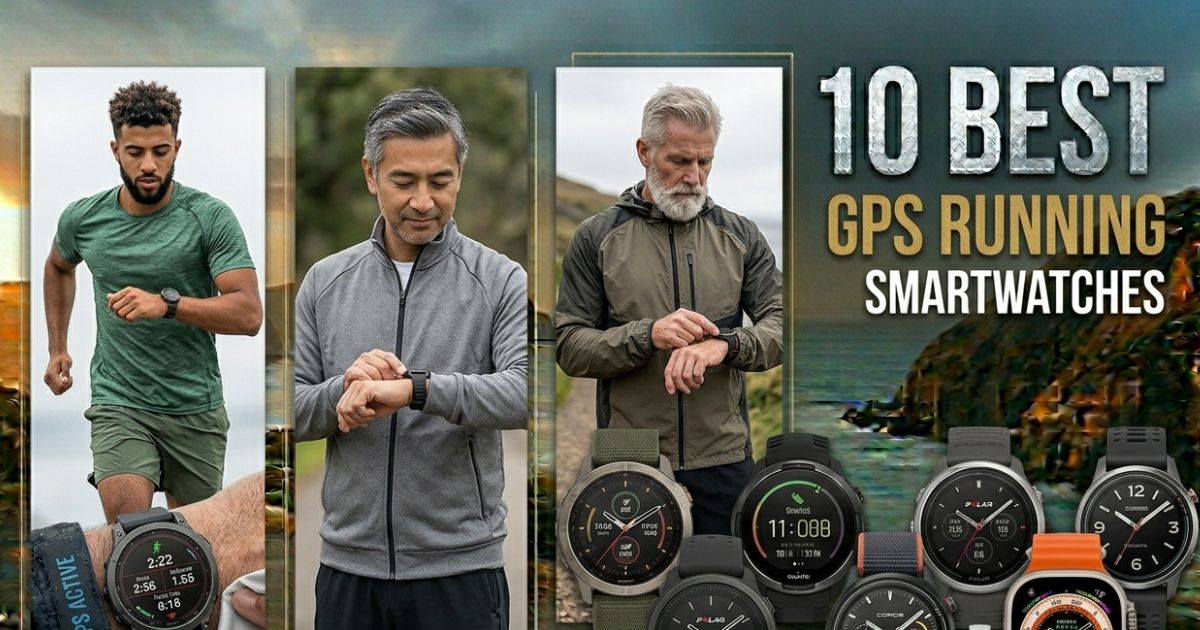

Choosing the right GPS running smartwatch means balancing accuracy, battery life, comfort, and smart features. A GPS running smartwatch is essentially a fitness watch built for runners it uses satellite-based GNSS (Global Navigation Satellite System) signals (like GPS, GLONASS, Galileo) to track your route, distance, pace, and elevation during workouts. These watches typically also include heart-rate monitors, altimeters, compasses, and other sensors to give you a complete picture of your performance. In this guide, we’ll compare the top 10 GPS running smartwatches of 2026, so you can find the best GPS running smartwatch for your needs.
GPS running watches rely on advanced satellite positioning to measure distance and pace accurately. For example, Garmin’s Forerunner 970 uses multi-band GNSS for industry-leading accuracy. In general, look for watches with dual-frequency GPS and multiple satellite systems for the most reliable tracking in urban or wooded environments. Battery life is another key factor: ultra-endurance models (like solar-charging Garmin Enduro 3) can track for days, while bright AMOLED-display watches (like the Apple Watch Ultra 3) often need daily charging. Other important features include optical heart-rate accuracy, onboard maps or navigation, durability (waterproofing, rugged build), and comfort on the wrist. Below we list the 10 best GPS running smartwatches all of which excel in GPS tracking and running features.
How to Choose a GPS Running Smartwatch
When shopping for a running watch with GPS, consider the following factors:
- GPS Accuracy & Signals: Look for multi-band or dual-frequency GNSS and support for multiple satellite systems (GPS, GLONASS, Galileo, etc.). High-end watches use advanced chipsets for consistent position accuracy even under tree cover or near buildings. For example, the Garmin Forerunner 970 locks onto satellites quickly and produces very clean route traces.
- Heart Rate Monitoring: Many running watches now include wrist-based heart-rate sensors. Some use improved optics or even chest-strap pairing. For reliability, note that watches like the Forerunner 970 and Garmin Enduro 3 tracked heart rate extremely accurately in tests (within 1 BPM). Choose a watch with a strong biosensor (Polar’s new Gen4 sensor on the Vantage V3, or Garmin’s Elevate v4, etc.) if precise heart-rate data is important.
- Battery Life: Battery is measured in hours of GPS use. Ultra-endurance watches (like Coros Vertix 2S or Garmin Enduro 3) can last 100+ hours in GPS mode or even weeks in low-power mode. Meanwhile, high-end AMOLED watches (Apple, Coros Apex 4, Polar Vantage V3) often give 20–50 hours of tracking, which is still plenty for most runners. Consider your typical run length: marathoners or adventure runners may prefer ultra-long battery.
- Display and Interface: Some watches have bright, easy-to-read AMOLED touchscreens (Suunto Vertical 2, Polar Vantage V3, Apple Ultra), while others use transflective memory-in-pixel (MIP) screens for battery savings (Coros Apex 4, older Garmin models). Touchscreens can be hard to use with gloves or sweat, so many running watches also include physical buttons (preferred by Garmin and Coros).
- Durability and Comfort: Trail runners often need rugged builds (titanium or steel bezels, sapphire glass) for shock resistance, plus high water resistance (typically 10 ATM). Weight matters too: light watches like Coros Pace 4 (32g) and Suunto Run (36g) can disappear on your wrist during a run. Make sure the strap is comfortable for long wear.
- Training Features: Look for running-specific features like built-in coaching, interval timers, training load/recovery metrics, and performance tests (VO2 max, running economy, etc.). All top models include basic pace/distance tracking, but brands differ on advanced metrics.
- Smartwatch Features: If you want music controls, contactless payments, or phone calls, be sure the watch supports them. Apple Watch and Samsung Galaxy Watches excel as smartwatches, while Garmin, Coros, and Polar focus more on sport features.
With these in mind, the following list highlights the best GPS running watches across categories from elite ultrarunner tools to budget-friendly trackers.
Top 10 GPS Running Smartwatches
-
Garmin Forerunner 970 (Best Overall) Garmin’s flagship running watch, the Forerunner 970 is lauded as the “most complete GPS running watch” Garmin has built. It combines a lightweight design (~56g) with a bright 1.4” AMOLED display and all the high-end GPS tech you need. In testing, the 970 excelled in accuracy: its multi-band GNSS chipset delivered extremely stable pace and distance on road and trail. It tracks extensive running metrics (Grade-Adjusted Pace, Hill Score, etc.) and even offers breadcrumb maps and turn-by-turn navigation. Battery life is around 23–26 hours of full GPS tracking (enough for long ultramarathons) with up to two weeks in smartwatch mode. Garmin also built in useful safety features like a front flashlight and satellite SOS on the Ultra model. The Forerunner 970 scored as OutdoorGearLab’s top pick overall, praised for its accuracy and comprehensive training tools.
- Pros: Best-in-class GPS accuracy and feature set; lightweight and comfortable; lots of advanced running metrics.
- Cons: High price (~$750); many features mean a learning curve; shorter battery than solar models.
-
Apple Watch Ultra 3 (Best for iOS Users) – Apple’s ruggedized smartwatch, the Apple Watch Ultra 3, doubles as a powerful training companion. It’s essentially a premium smartwatch with advanced fitness tracking: the Ultra 3 adds an improved battery (up to 14h GPS), a very large 1.9” Retina display, and emergency satellite connectivity. GPS performance is excellent (Apple’s data shows accurate pace and route tracking), and the Ultra includes advanced health sensors and safety tools (crash detection, 86dB siren, etc.). If you primarily run on roads or groomed trails and want a blend of running features with smartwatch conveniences (notifications, Apple Pay, music), it’s a great choice. The main drawback is battery life – about 14 hours of GPS (which is less than dedicated running watches) – and no Android support. Battery improvements this year allow up to 42h regular use or 72h in low-power mode.
- Pros: Seamlessly blends lifestyle and running features; superb build quality and user interface; emergency satellite messaging for backcountry safety.
- Cons: Shorter battery in GPS mode (~14h) compared to Garmin/Coros; only works with iPhone; touch screen is hard to use with gloves.
-
Coros Apex 4 (Best Midrange Running Watch) – The Coros Apex 4 is a standout value-for-performance watch. It features a durable sapphire screen, a physical action button, and a 1.2” MIP display (switchable to white background for visibility). Coros packed it with features: dual-band GPS, offline maps support, voice alerts and pins, and gym functionality. Remarkably, the Apex 4 delivers 41 hours of continuous GPS tracking far above most AMOLED watches due to its low-power MIP screen. The user interface is run-centric and simple to navigate mid-workout (the side button toggles maps or alerts instantly). In testing, the Apex 4’s GPS lock was “near-instant” and pacing was very consistent, matching the performance of pricier watches. Coros also added one of its most advanced voice assistant features: you can dictate short voice notes (“Just took a gel”) mid-run to recall later. Overall, this watch earned praise for combining rugged durability with a clean running focus. OutdoorGearLab calls it the best bang-for-your-buck GPS watch, and iRunFar noted it’s “one of the best performing watches out there” for runners on a budget.
- Pros: Excellent battery (41h GPS) for its class; precise GPS and robust mapping; rugged build (sapphire glass, titanium).
- Cons: Display isn’t as sharp as AMOLED; limited color options; no touchscreen navigation.
-
Coros Pace 4 (Best Lightweight Runner’s Watch) – Weighing just 32g, the Coros Pace 4 is ultralight yet full-featured for road runners. It sports a 1.2” AMOLED screen (surprisingly bright and easy to read on the run) and a very snappy interface. Battery life is impressive for such a small watch OutdoorGearLab found 40 hours of GPS use (the longest at its price point). Normal daily wear with always-on display still lasted about a week before charging, and a gesture-activated screen pushes it to ~19 days. The Pace 4 has built-in running metrics (lap undo, workouts, Effort Pace) and accurate GPS tracking. User reports (and reviews) note its optical heart-rate is reliable for most runs; for cold-weather intervals, you can pair a chest strap. The watch is nearly the lightest GPS watch ever tested and “disappears on the wrist” during runs. As Alastair Dixon (AlastairRunning) puts it, at $249 it’s “incredibly well-priced, offering unbeatable value for money” and the daily go-to for road running.
- Pros: Ultralight and comfortable on the wrist; long GPS battery life (40h) for the price; bright AMOLED display.
- Cons: No full offline maps (breadcrumb navigation only); basic smartwatch features (no music, payments, or phone calls).
-
Garmin Enduro 3 (Best for Ultra Endurance) – The Garmin Enduro 3 is engineered for ultras and expeditions. It’s essentially a Fenix-class watch with maximum battery: up to 320 hours of GPS tracking with solar charging (120 hours without sun). The Enduro 3 keeps the weight relatively low (considering its 51mm size) and includes an LED flashlight, tactical features, and buttons ideal for gloved use. It also has a large, high-resolution display that’s easy to read outdoors. Accuracy is superb; in lab tests it tracked distance and heart rate with the highest precision. Garmin’s user interface is intuitive, and the watch includes all the advanced features of a Fenix (altimeter, barometer, topo maps, etc.). For runners tackling multi-day trail events or those who want minimal charging, this is the top choice. OutdoorGearLab awarded it their Best for Expeditions title, noting it’s “our top choice for serious ultra-athletes”.
- Pros: Unmatched battery life (320h GPS) with solar boost; robust design and accuracy; built-in flashlight and topo maps.
- Cons: Very large 51mm case (may be too big for small wrists); expensive (~$900); heavy for everyday wear.
-
Suunto Vertical 2 (Best Display & Battery) Suunto’s Vertical 2 combines top-tier hardware with sleek Scandinavian design. It features a 1.5” AMOLED touchscreen (the largest here) and a titanium or steel case. Despite the power-hungry screen, it still manages almost 60 hours of full-accuracy GPS tracking per charge, and 200+ hours in power-save mode. In testing, its GPS accuracy was “exceptional,” and it includes all the navigation tools (offline color maps, route guidance, back-to-start) you’d expect from a premium outdoor watch. The Vertical 2 stands out for design: many reviewers call it the most aesthetically pleasing GPS watch, thanks to clean lines and a beautifully integrated AMOLED. Suunto added a novel front-facing flashlight for night use and kept the watch surprisingly comfortable despite its 54mm face (thanks to a curved profile). The interface is intuitive for trails, and the straps are ultra-comfortable. iRunFar praised the Vertical 2’s display and battery as “outstanding” and noted that GPS accuracy and a new optical HR sensor “rival your old chest strap”. If you want a high-end outdoor watch with stunning visuals and great battery, the Vertical 2 is a winner.
- Pros: Gorgeous large AMOLED screen; very strong battery life for a bright display; premium build (titanium/steel).
- Cons: Bulky (54mm) and may feel heavy on small wrists; feature set is broad but may be more than needed for pure road runners.
-
Amazfit T-Rex Ultra 2 (Best Rugged Value) – Amazfit’s T-Rex Ultra 2 (formerly “T-Rex Ultra”) delivers rugged durability and excellent battery at a midrange price. With a Grade 5 titanium chassis and 1.5” AMOLED screen, it feels as solid as many $800 watches. Battery life is a standout: the Ultra 2 claims 30 days in basic watch mode, and in practice can run 30–40 hours with GPS active. It also has full-color maps on board and a built-in dual-color flashlight (white and red LEDs) – features usually seen only on premium Garmin/Suunto models. GPS and heart-rate accuracy are very good; Amazfit has even sponsored professional runners, showing confidence in their tracking. The Ultra 2 omits a speaker or microphone (no voice calls) and has a simpler app ecosystem, but it focuses on what adventurers need: navigation and endurance. As iRunFar puts it, it “focuses on what many athletes actually need: durability, long battery life, mapping, and strong everyday usability” at a ~$550 price. This watch is excellent for trail runners and outdoor adventurers who want a tough watch without Garmin’s high price.
- Pros: Rock-solid build (titanium bezel); superior battery (days of GPS use); full-color offline maps and unique dual-beam flashlight.
- Cons: Bulkier size; lacks a mic/speaker (no calls or voice assistant) and satellite SOS.
-
Amazfit T-Rex 3 Pro (Best Value GPS Watch) – Amazfit’s T-Rex 3 Pro is a slightly lighter, midrange rugged watch. It boasts a very bright 1.5” AMOLED display – iRunFar called it “the brightest and most vivid screen we’ve tested”. It has rugged yet refined styling, a sapphire lens, and all-day durability. GPS accuracy is strong in open areas (tracking stability is on par with Coros’ higher-end models), and the watch performed impressively in dense trail tests with only occasional small “wobbles”. Battery life is also a highlight: it achieves about 38 hours of dual-band GPS use, which means you can train for a few days on one charge even with always-on display enabled. Amazfit’s Zepp app provides good health metrics (stress, sleep, recovery) and the watch offers turn-by-turn navigation, music controls, and a growing app library. In short, the T-Rex 3 Pro gives Garmin Fenix-level features (maps, analytics) at roughly half the cost, making it the best value GPS watch we tested.
- Pros: Amazing bright AMOLED display; strong GPS accuracy and battery (38h) for the price; rugged and water-resistant.
- Cons: Software/app ecosystem is less polished than Garmin’s; Amazfit’s AI-driven metrics (Stress etc.) may feel gimmicky.
-
Polar Vantage V3 (Best for Data and Recovery) – The Polar Vantage V3 is Polar’s newest premium multisport watch. It packs an AMOLED display, a dual-frequency GPS receiver, and an impressive suite of sensors (wrist ECG, Gen4 OHR, SpO2, skin temp). Battery life is solid: 43h in full GPS mode, and up to 140h in low-power (Eco) mode. Polar’s strength is advanced training and recovery metrics: V3 includes a full array of Polar features like Training Load Pro, Recovery Pro, running power, and sleep analysis. It also offers route navigation with maps/breadcrumbs. The watch design is sleek (aluminum case) and includes smart features like music controls and notifications. In our context, the Vantage V3 is ideal for runners who want Garmin-level accuracy with extensive biofeedback. The Polar website touts it as “the most comprehensive suite of training and recovery tools on the market”. While slightly lower profile than the Triathlon-focused Grit X2, the V3 excels in day-to-day training support. It’s a great choice for serious athletes who value data depth and heart-rate accuracy.
- Pros: Advanced training and health metrics (ECG, skin temp, etc.); high GPS accuracy (dual-frequency) and good battery life; built-in maps and navigation.
- Cons: Premium price (~$700); feature set may be overkill for casual runners; Polar ecosystem still catches up to Garmin’s in app richness.
-
Polar Grit X2 (Best Challenger for Outdoors) – Polar’s Grit X2 is a rugged outdoor multisport watch (the non-Pro version). It has a 1.28” AMOLED display and offers about 30 hours of GPS tracking (enough for most adventures). Polar improved the design (nicer strap, smaller case) over the original Grit X, and it can withstand mountains, making it a true “challenger” model. In practice, the Grit X2 delivers reliable dual-band GPS tracking and heart-rate measurement. Reviewers note it’s “well-rounded, highly capable” with accurate navigation and bio-sensing. It supports Polar’s coaching programs and has a quirky but capable interface. The X2 may not grab headlines like Garmin or Apple devices, but it quietly competes on accuracy and durability. It’s ideal for trail runners who want strong performance analytics and Polar’s commitment to heart-rate accuracy.
- Pros: Rugged build; dual-band GPS and accurate HR monitoring; AMOLED screen and solid battery (~30h GPS).
- Cons: Expensive (~$800) for what it offers; fewer 3rd-party apps and simpler UI than Garmin; no offline map display.
GPS Accuracy and Battery Life
All the watches above excel at GPS accuracy, using advanced chipset technology. For example, in head-to-head tests the Garmin Forerunner 970, Garmin Enduro 3, and Apple Watch Ultra 3 all tracked heart rate within 1 BPM of a lab-grade monitor. The Coros Pace 4 and Apex 4 also performed very well; in fact, OutdoorGearLab explicitly recommends the Forerunner 970 and Coros Pace 4 as the top choices “for running” due to their accuracy and usability. Entry-level and value watches like the Amazfit T-Rex 3 Pro can surprise you with strong GPS tracking under open skies, though they may lose out in dense forests or urban canyons compared to Garmin’s premium chips.
Battery life varies widely: from 14–26 hours (Apple Ultra, Garmin Forerunner 970) on the lower end, up to over 100 hours (Coros Vertix 2S, Garmin Enduro 3) on the high end. Dual-frequency GPS mode and full maps will shorten battery life, so most watches offer power-saving GPS modes that extend range. For most users, 20–40 hours of full GPS tracking is plenty; however, ultra-runners and adventure athletes should lean toward watches like Garmin Enduro 3 (120–320h) or the Coros models with XXL battery. In all cases, you can expect far less runtime when always-on maps or streaming music is in use.
Conclusion
In summary, the best GPS running smartwatches for 2026 span a range of prices and styles. If you want the overall best performance, Garmin’s Forerunner 970 is tough to beat in accuracy and features. Apple Watch Ultra 3 is the top choice for iPhone users who value a polished smartwatch experience on the trails. Coros offers two standout running watches: the rugged Apex 4 (best all-around runner) and the Pace 4 (best lightweight value). For ultra-endurance, Garmin’s Enduro 3 leads the pack with solar charging. Suunto’s Vertical 2 shines for display and design, while Amazfit’s T-Rex series delivers remarkable value and battery life. Finally, Polar’s Vantage V3 and Grit X2 cater to data-focused athletes who want precise monitoring and recovery insights.
Each of these watches has its strengths. Consider what matters most to you whether it’s GPS accuracy, battery longevity, comfort, or advanced training metrics – and choose accordingly. With any of the models above, you’ll have a powerful GPS running watch on your wrist to guide and track your runs.
Ready to pick your next GPS running smartwatch? Compare features, read reviews, and look for deals from trusted retailers. Track your runs with confidence knowing your watch has the precision you need.
