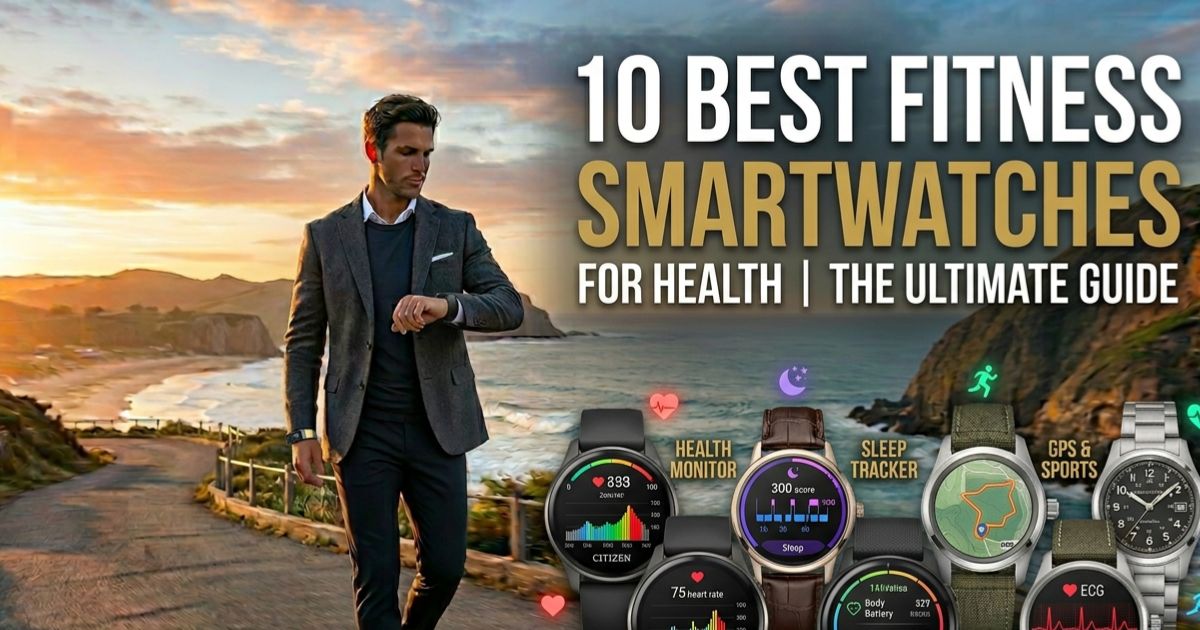

An increasing number of people buy fitness smartwatches for health monitoring rather than just notifications. These wearables use built-in sensors (heart-rate monitors, SpO₂ sensors, etc.) and apps to track exercise and deliver advanced health insights. Modern fitness smartwatches can continuously monitor your heart rate, sleep stages, blood oxygen, and even electrodermal activity (stress) while providing GPS tracking for workouts. In fact, “the best fitness smartwatches have evolved into highly accurate health monitoring devices” with features like 24/7 heart-rate monitoring, detailed sleep analysis, and built-in GPS. This guide reviews the top 10 fitness-focused smartwatches of 2026, comparing their key features (heart rate, GPS, battery, etc.), pros/cons, and tips to help you choose the right one.
Fitness smartwatches let you monitor vitals, log workouts, and even use AI coaching on your wrist. For example, as Android Central notes, today’s fitness watches combine “built-in GPS and stress monitoring” with “detailed sleep stages and 24/7 heart rate monitoring” for a comprehensive health picture. A systematic study also found that wearable heart-rate and SpO₂ measurements agree closely with medical devices – meaning these watches are generally reliable for tracking your health trends. In short, a good fitness smartwatch is a powerful tool to stay on top of your health. In this article, we’ll break down the best health-tracking watches, highlight important sports smartwatch features, and explain what to look for (GPS, battery life, durability, etc.) so you can make an informed choice.
Key Features to Look for in a Fitness Smartwatch
Before diving into our list, here are the essential health and sports tracking features to consider in a fitness smartwatch:
- Continuous Heart-Rate Monitoring: A 24/7 heart-rate sensor is a must-have. Resting heart rate is one of the best fitness indicators. Look for watches that sample your heart rate often (ideally every second during workouts and regularly at rest).
- Blood Oxygen (SpO₂) Sensor: Measures blood oxygen saturation. Useful for tracking recovery, altitude adaptation, and detecting breathing issues during sleep.
- GPS Tracking: Built-in GPS (especially dual-band or multi-band) is critical for runners and outdoor workouts to map pace, distance, and routes. Dual-band GPS (e.g. L1+L5) provides more accurate positioning in cities or woods.
- Sleep Tracking: Good fitness watches break sleep into light, deep, and REM stages. Quality sleep tracking lets you see how factors (like late coffee) affect your rest. Many watches now compute a Sleep Score to summarize sleep quality.
- Battery Life: Aim for at least a week of real use (including overnight tracking). Long battery life ensures continuous data – no one wants to charge nightly. Several watches below offer multi-day (or even multi-week) battery life.
- Sports Modes: The watch should support sports modes you use (running, cycling, swimming, strength training, etc.). Some high-end models even have triathlon or multisport modes.
- Durability: For exercise and outdoor use, look for water resistance (5ATM or more) and rugged construction. Military-grade standards or sapphire glass on screens are pluses if you want extra durability.
- Smart Features: If desired, check for extras like music storage, contactless payments (NFC), smartphone notifications, or voice assistant support.
With these features in mind, let’s explore the 10 best fitness smartwatches for health. Each entry includes key specs, health-tracking highlights, and pros/cons based on expert reviews.
1. Garmin Venu 4 – Best Overall Fitness Smartwatch
Garmin’s Venu 4 is a top pick for fitness and health tracking. It has a bright AMOLED touchscreen (1.2″ or 1.4″) and a long battery life (up to 12 days in smartwatch mode). For health tracking, the Venu 4 includes Garmin’s latest Elevate v5 optical heart-rate sensor and SpO₂ sensor, as well as an ECG and skin-temperature sensor. This lets you monitor heart rate, blood oxygen, stress (via HRV), and temperature changes 24/7. It even offers a “Body Battery” energy score and personalized Sleep Coaching for better rest. Built-in GPS (multi-GNSS support) accurately logs runs or walks.
The Venu 4 also has advanced workout modes: animated on-screen exercises, strength training, yoga, and 40+ sports modes. It can generate recovery time estimates and breakdown workout benefits (a VO₂ max effect screen) after each activity. On the smart side, it supports Bluetooth calling, music storage, Garmin Pay, and voice assistant passthrough.
Pros: Gorgeous OLED display; superb battery life; all-day health tracking (HR, SpO₂, stress, ECG); built-in GPS for running; sleep coaching features.
Cons: Premium price; Garmin’s app ecosystem is more fitness-focused (fewer third-party apps); no touchscreen keyboard for messaging.
Bottom Line: Garmin Venu 4 is a powerhouse fitness watch with extremely accurate tracking and a host of health insights (and yet a watch battery life measured in days). It’s one of the best overall health-tracking smartwatches if you want robust metrics and long runtime.
2. Google Pixel Watch 4 – Best for Android Fitness
Google’s Pixel Watch 4 (2025) is an Android Wear OS smartwatch with Fitbit’s health tracking under the hood. It runs the new Snapdragon W5 Gen 2 chip for snappy performance and comes in two sizes (41mm/45mm). Health tracking on Pixel Watch 4 is a highlight: it has Fitbit’s sensors for continuous heart rate, SpO₂, skin temperature, EDA (electrodermal) stress monitoring, and even on-wrist ECG. These cover all the essential health metrics (heart, oxygen, stress, sleep) in one device. You even get Fitbit Premium trials for deeper insights in the app.
The watch includes GPS (dual-frequency) for run tracking, and water resistance for swim workouts. Battery life is modest (about a day) but acceptable given the bright 1.4″ AMOLED display and always-on mode. Pixel Watch 4 also offers a built-in mic for Google Assistant, NFC for Google Pay, and works well with Android phones.
Pros: Stylish circular AMOLED display; Snapdragon W5+ performance; Fitbit health sensors (HR, SpO₂, ECG, stress); GPS and voice assistant; large app ecosystem on Wear OS.
Cons: Shorter battery life (~24h); limited durability (no sapphire glass); requires Pixel/Android OS for full features.
Bottom Line: The Google Pixel Watch 4 is ideal for Android users who want serious health tracking (Fitbit-level metrics) on their wrist. It’s perhaps the best GPS fitness smartwatch for Android, blending a round watch design with top-tier sensors.
3. Coros Pace 3 – Best Budget Running Watch
The Coros Pace 3 is a lightweight, affordable sports watch that punches above its weight. It’s built for runners and triathletes: it has dual-frequency GPS (multiband) for very accurate tracking and a wide variety of training features. Coros advertises a battery life of up to 24 days in regular mode and about 38 hours with GPS on. In practice, expect roughly 2+ weeks of typical use, or several sessions of GPS activity.
For health tracking, Pace 3 includes next-gen sensors: an optical heart-rate monitor and SpO₂ sensor (pulse oximeter) for oxygen saturation. It also has a barometric altimeter, compass, and accelerometer. 24/7 data includes resting heart rate, blood-oxygen, and sleep tracking (via the Coros app). New firmware updates have added “HRV stress” monitoring and detailed run analysis (ground contact time, etc.).
Pros: Exceptional battery life; lightweight (only ~30g); dual-band GPS for precise run tracking; coaching tools like EvoLab (training load and recovery insights); affordable price.
Cons: No NFC/payments; no on-watch music; basic smartwatch features (no voice or apps); fit can be a bit fiddly.
Bottom Line: Coros Pace 3 is a running-oriented fitness watch at a great price. It nails the core sports features (GPS, training load, recovery) and still offers basic health metrics (HR, SpO₂). For serious runners on a budget, it’s one of the best choices.
4. Samsung Galaxy Watch Ultra – Best for Adventure and Battery
Samsung’s new Galaxy Watch Ultra (47mm titanium) is designed for rugged use and long sessions. It’s essentially a “pro” Galaxy Watch with beefier battery and extra features. The Ultra now uses Wear OS 4 and packs a Snapdragon chip, but the star is health and sports features. It adds dual-frequency GNSS (multi-band GPS) for better satellite lock, and Samsung’s new BioActive Sensor that merges optical heart rate, electrical (ECG) and bioimpedance in one. DCRainmaker notes the Ultra finally has a “more accurate” optical HR sensor.
For health, the Galaxy Watch Ultra supports Samsung Health Monitor apps: ECG, blood pressure (with calibration), and the new FDA-approved sleep apnea detection. It also includes a running “Race” mode (pace coaching) and a built-in loud emergency siren. Its battery is improved Samsung claims around 48 hours normal usage or up to 100 hours in power-save workout mode (roughly 3+ days real-world).
Pros: Premium build (titanium + sapphire glass); dual-band GPS; enhanced health sensors (HR, ECG, SpO₂); durable (MIL-STD-810); special fitness modes (triathlon, FTP cycling, etc.).
Cons: Heavy on the wrist (60g); some features locked to Samsung phones; still not as many apps as Apple.
Bottom Line: The Galaxy Watch Ultra is Samsung’s answer to the Apple Watch Ultra a rugged fitness smartwatch with top health sensors and long battery life. It’s ideal for serious athletes or adventurers who need GPS/training modes plus all-day health tracking.
5. Fitbit Sense 2 – Best for Stress & Health Tracking
Fitbit’s Sense 2 is a health-oriented smartwatch known for comprehensive sensors. It tracks heart rate (constant and in workouts), blood oxygen (SpO₂), skin temperature, and even electrodermal activity (EDA) to measure stress. It also offers on-wrist ECG for atrial fibrillation detection. The Sense 2 provides detailed sleep staging and a Sleep Score, plus guided breathing and stress management tools.
On the fitness side, it has built-in GPS for runs, and over 40 exercise modes with on-screen animations. Battery lasts about a day and a half (17+ hours), which is better than most WearOS models. Sense 2 also integrates with Fitbit Premium (optional) for deeper analytics.
Pros: Broad health sensors (HR, ECG, SpO₂, EDA stress); solid sleep and wellness tracking; comfortable design; Fitbit community and app are mature.
Cons: Requires Fitbit Premium for some features; battery life is average; no third-party apps (Fitbit OS).
Bottom Line: Fitbit Sense 2 is one of the best health-tracking smartwatches on the market. Its combination of ECG, SpO₂, and stress tracking makes it a standout for monitoring wellbeing, ideal for users who prioritize health metrics.
6. TicWatch Pro 5 – Best Wear OS Alternative
The Mobvoi TicWatch Pro 5 is a Wear OS smartwatch (Android-friendly) that also boasts strong fitness features. It runs Qualcomm’s Snapdragon W5+ chipset for smooth operation. Notably, it has a huge 628 mAh battery and an “Essential Mode” that extends it further. In practice, you can get around 2 days normal use, or much longer if you drop into the low-power mode.
Fitness-wise, the Pro 5 offers a MIL-STD-810G-certified rugged build, dual-band GPS, and fitness coaching features. Its sensors include continuous heart-rate, SpO₂, and skin temperature monitoring. TicWatch also offers an “OLED + FSTN” dual-layer display: a power-saving secondary screen for time/activity in sunlight. The watch runs Wear OS 3 (upgradeable to 4), so it has Google Fit, YouTube, maps, etc.
Pros: Strong hardware (W5+, dual screens); accurate HR and SpO₂ sensors; very long battery life (especially in Essential Mode); rotating crown for easy control.
Cons: Wear OS has fewer fitness apps than Apple/Pixel; larger and heavier than simpler watches; Premium Wear OS features (like Assistant) require Google Play account.
Bottom Line: For Android users who want Wear OS with great battery and tracking, TicWatch Pro 5 is a solid pick. It offers the flexibility of Wear OS plus robust sports tracking features.
7. Garmin Forerunner 265 – Best for Runners
The Garmin Forerunner 265 is a runner’s GPS watch that’s also great for health metrics. It’s essentially a Forerunner 255 with a vibrant AMOLED touch display. Key features include all-systems GNSS (GPS/GLONASS/Galileo) with dual-band support, an optical heart-rate sensor, pulse oximeter, and a built-in music player with 8GB storage. Battery life is about 11 days in smartwatch mode (12 with the smaller 39mm version).
For running training, Forerunner 265 shines: it provides Garmin Coach workouts, training readiness scores, extensive performance metrics (VO₂ max, training load), and recovery time recommendations. It supports multisport modes (swim, bike, gym). On health, it tracks all-day heart rate, blood oxygen, stress, and sleep, syncing to Garmin Connect. It lacks a speaker/mic (no phone calls) but has NFC for Garmin Pay.
Pros: Expert running features (interval training, triathlon modes); dual-band GPS and bright AMOLED display; long battery; advanced health tracking (HR, SpO₂).
Cons: No music control on-device; plastic case feels less premium; fairly heavy for smaller wrists.
Bottom Line: If running performance is your focus, the Forerunner 265 is hard to beat. It’s a fitness-focused GPS watch that still covers health basics (heart rate, sleep) while giving runners elite training guidance.
8. Amazfit Balance 2 – Best Affordable Beginner Watch
The Amazfit Balance 2 is an affordable full-featured smartwatch aimed at beginners. It features a bright 1.5″ AMOLED display and a battery life of around 14 days normal (up to 9 days heavy use). For tracking, it includes BioTracker PPG optical heart-rate, SpO₂, and stress sensors, as well as built-in dual-band GPS for running or outdoor sports.
This watch has an aluminum alloy body and sapphire glass for a premium feel at a mid-range price. It offers over 150 sports modes, auto exercise detection, and animated workout guidance. Amazfit’s Zepp OS 3.0 provides guided AI-based training programs and even LLM food logging. Performance-wise, it runs a newer chipset for smoother UI. One cool feature is onboard speakers for making calls or using the voice assistant.
Pros: Very competitive price; continuous HR, SpO₂, and stress tracking; dual-band GPS; large AMOLED display with sapphire glass; AI fitness coach features.
Cons: Amazfit’s app (Zepp) still has minor bugs; fewer third-party apps; accuracy of some auto-detected workouts can vary.
Bottom Line: For a budget-friendly health watch, the Amazfit Balance 2 delivers a lot: solid sensors, GPS, and smart features. It’s an excellent starter watch for someone new to fitness tracking.
9. Apple Watch Ultra 3 – Best for iPhone Users
The Apple Watch Ultra 3 is Apple’s most advanced fitness smartwatch to date. It has a large 49mm titanium case and an always-on OLED display (3000 nits). Its strengths are safety and metrics: Ultra 3 includes Apple’s latest health sensors (heart rate, SpO₂, ECG) and adds new features. Importantly, it now offers hypertension monitoring (alerting you to possible high blood pressure after 30 days) and a built-in Sleep Score in iOS Health. It also supports Food Logging and Activity Coaching via watchOS.
This model has a massive battery bump – about 42 hours normal use, or up to 72 in low-power mode. With quick charging, you can get 12 hours of use from a 15-minute charge. Ultra 3 also has emergency satellite SOS and an 86db siren for outdoor safety. It’s fully waterproof to 100m (for diving) and has an Action button for starting workouts or wayfinding.
Pros: Rugged design (sapphire + titanium); long battery life (2+ days); advanced health features (hypertension alert, sleep analysis); precise GPS/GNSS; Emergency SOS via satellite.
Cons: Very large for small wrists; very expensive; many features only work with iPhone.
Bottom Line: If you have an iPhone and want a feature-packed sports watch, Apple Watch Ultra 3 is hard to top. It combines Apple’s ecosystem (great health app ecosystem) with enhanced tracking and safety for athletes. (For more budget-conscious iPhone users, the regular Apple Watch Series 11 is also excellent, but the Ultra 3 is geared toward the most active.)
10. Withings ScanWatch Light – Best Hybrid Health Tracker
The Withings ScanWatch Light is a hybrid smartwatch (analog hands + hidden PMOLED display) that shines as a health tracker. It doesn’t have built-in GPS; instead it uses your phone’s GPS for runs. What it does offer is ECG monitoring and clear health metrics. It can track heart rate, respiratory rate, and sleep quality, and even log symptoms via the Withings app. It includes a wrist-based ECG (to check for atrial fibrillation) and high-quality sleep analysis (including apnea notifications if breathing drops).
A major advantage is battery life: ScanWatch Light lasts up to 30 days on a charge, far outlasting typical smartwatches. The design is sleek and water-resistant to 5 ATM, so you can swim with it. It’s not a full-screen smart device, but it will display steps, heart rate, and notifications on its small display when you touch the face.
Pros: Unmatched battery life (about a month); medical-grade ECG; continuous heart rate and respiratory monitoring; lightweight and stylish.
Cons: Limited as a “smart” device (no app store, music, or voice assistant); relies on phone for GPS; smaller display can’t show much data at once.
Bottom Line: Withings ScanWatch Light is designed for health-first users. It’s the best choice if you want simple, accurate health monitoring and don’t need apps or constant screen time. It earned Wareable’s top spot due to its exceptional sleep and vital-sign tracking.
Conclusion
The 10 fitness smartwatches for health above each excel in different ways, but all provide solid monitoring of key health metrics. In summary:
- If you want comprehensive health features and battery life in one package, consider the Garmin Venu 4 or Apple Watch Ultra 3. They track everything from heart rate to sleep with long runtimes.
- For Android users, the Google Pixel Watch 4 and Samsung Galaxy Watch Ultra offer top-tier health tracking (Fitbit integration or Samsung’s sensors) with built-in GPS.
- Runners will love the Coros Pace 3 or Garmin Forerunner 265 for their precise GPS and training feedback.
- If budget is a concern, the Amazfit Balance 2 gives you most essential tracking and GPS at a low price.
- And if you prioritize health monitoring above all, hybrids like Withings ScanWatch Light bring clinical-grade ECG and multi-day battery life.
Remember, accuracy tends to be excellent for core metrics: a recent study found smartwatch heart-rate and SpO₂ readings closely match clinical devices. Still, fit is crucial – wear the watch snugly for best sensor contact.
Tip: Choose a watch that fits your phone (iOS vs Android) and lifestyle. For example, Apple users naturally pick Apple Watch, while runners might lean toward Garmin or Coros. Check for the specific features you need (ECG? ECG? Coach modes? etc.) in the spec sheet.
Ultimately, the best fitness smartwatch for health is the one you’ll wear daily. They all cover basics (steps, HR, sleep), so focus on extras you value: on-watch workouts, music, contactless pay, or simply battery life. With this guide, you can compare specs and reviews to make an informed choice. Stay healthy, and happy tracking!
