

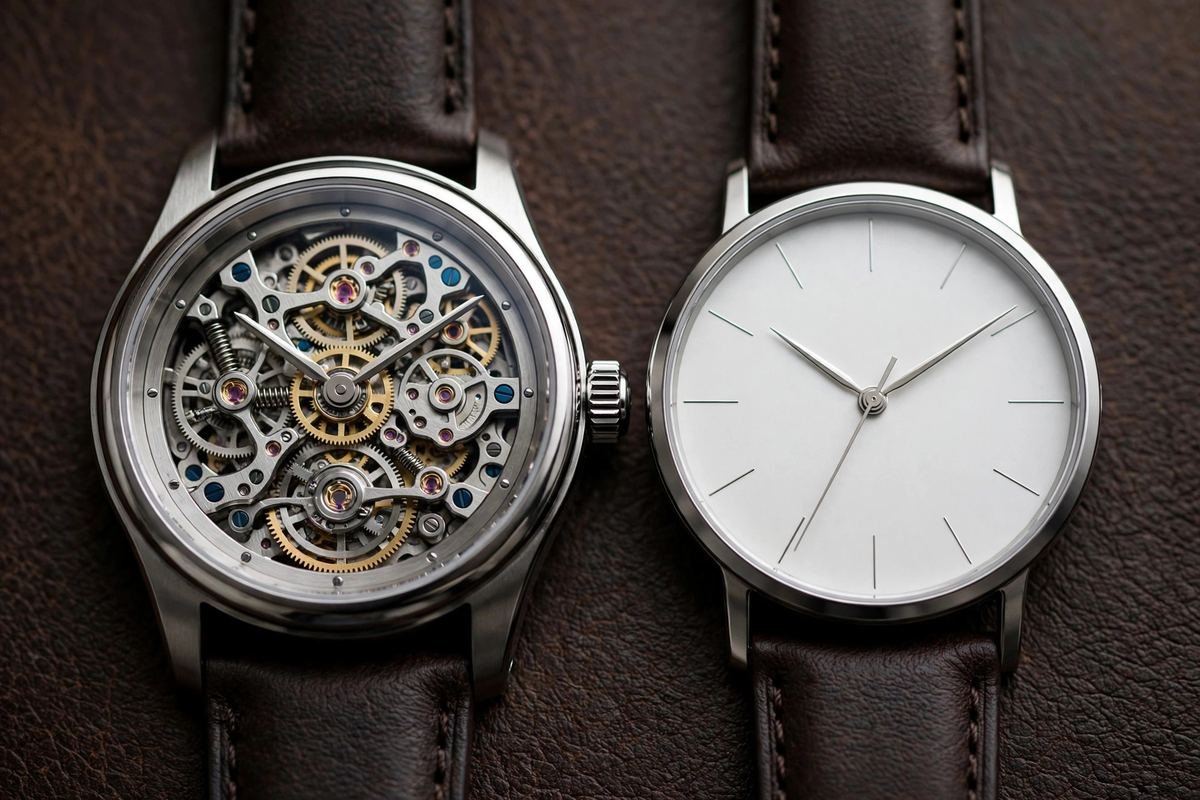
The debate over automatic vs quartz watches is the oldest argument in modern horology, and it still confuses first time buyers. An automatic watch is powered by the motion of your wrist winding a mainspring, a tiny mechanical engine with over a hundred parts. A quartz watch is powered by a battery sending current through a vibrating crystal, a triumph of electronics that keeps near perfect time. Both tell time, but they offer completely different ownership experiences.
So in the automatic vs quartz watches debate, which is better for you? Quartz vs automatic accuracy is no contest on paper: a basic quartz movement drifts seconds per month while even a fine automatic drifts seconds per day. But accuracy is not the whole story. Watch movement types explained properly include soul, craft, maintenance, and cost, and this is where automatics fight back. The pros and cons of automatic watches center on mechanical charm versus servicing bills, while quartz watch advantages center on precision and freedom from maintenance.
This guide compares ten real watches, five automatics and five quartz, across the full price spectrum, so you can feel the difference instead of just reading theory. We cover automatic watch maintenance cost honestly, explain choosing a watch movement for your lifestyle, and weigh mechanical vs quartz movement tradeoffs with real numbers. Published by All Watch Today, this automatic vs quartz watches guide is the no nonsense comparison we wish someone had handed us before our first purchase.
Quick Picks: Automatic vs Quartz Watches at a Glance
Five watches that define each side of the debate. For more head to head buying advice, visit our buying guides and comparisons section.
- Best Automatic Overall: Seiko 5 Sports SRPE, the affordable mechanical icon.
- Best Automatic Upgrade: Hamilton Khaki Field Auto, Swiss heritage under 650 dollars.
- Best Quartz Overall: Citizen Eco-Drive BM8180, solar power means never changing a battery.
- Best Budget Quartz: Casio MQ24, twenty dollars of unbeatable simplicity.
- Best Conversation Piece: Bulova Lunar Pilot, the moon watch story in quartz form.
How to Choose Between Automatic vs Quartz Watches
Start with your relationship to maintenance. An automatic needs wearing or winding to stay running, gains or loses seconds daily, and requires a professional service every five to seven years costing 100 to 300 dollars. A quartz needs a battery every two to five years costing a few dollars, or no battery at all if it is solar, and it will be within seconds per month without any attention. If you want a watch you can ignore for months and still trust, quartz wins. If you enjoy the ritual of winding and the romance of gears, automatic wins.
Next, consider your rotation. Automatic watches thrive on daily wear because the rotor keeps the mainspring charged, and a watch winder or manual winding covers the days you skip. Quartz watches do not care if you ignore them for a year, they will be ticking and accurate when you return. One watch collectors often love automatics for the daily bond, while multi watch collectors often prefer quartz for the pieces they wear occasionally. Our blog has a full guide to building your first rotation if you want more detail.
Be Honest About Accuracy Needs
A standard quartz movement is accurate to about 15 seconds per month, while a good automatic is accurate to about 15 seconds per day. In practice, nobody misses appointments because of an automatic, since you naturally reset it when you notice drift. But if you set your watch once and expect it right months later, or you coordinate precisely timed activities, quartz is the rational choice. Do not let romance override reality if precision matters to your daily life.
Count the Total Cost, Not Just the Price
Automatic watch maintenance cost is the hidden variable most guides gloss over. Budget 150 to 250 dollars every five to seven years for a basic service, more for Swiss pieces, and factor in that a 200 dollar automatic may cost nearly its purchase price to service. Quartz service is a battery swap costing under 10 dollars, or free forever with solar. Over a decade, a cheap automatic can cost more to own than a mid range quartz.
Think About What Brings You Joy
Watches are emotional objects, and the movement you love looking at matters. Many owners wind their automatics each morning the way others brew coffee, finding pleasure in the ritual itself. Others find joy in a quartz watch that simply works, every time, without demands. There is no wrong answer here, only the honest one about which experience you will still enjoy in five years.
The 10 Best Automatic vs Quartz Watches Compared
First, five automatics that show what mechanical watchmaking offers at every budget, then five quartz watches that show what electronics do best.
1. Seiko 5 Sports SRPE51
The Seiko 5 Sports SRPE is the gateway automatic, typically 200 to 250 dollars for a watch with an in house 4R36 movement offering hand winding, hacking, and a day date. The 40mm case wears comfortably, 100 meter water resistance covers daily life, and the dial options range from classic black to bold colors. It is the watch that convinces thousands of buyers that mechanical is worth the trouble.
- Seiko 4R36 automatic with 24 jewels, hand winding, and hacking seconds.
- 100 meter water resistance with a unidirectional dive style bezel.
- Day date complication at 3 o clock.
- 40mm case that suits nearly every wrist.
Pros: Genuine in house automatic at a fair price, robust and serviceable, huge enthusiast community. Cons: Hardlex crystal scratches, accuracy varies by example, and bracelet is basic.
2. Hamilton Khaki Field Auto H70455533
The Hamilton Khaki Field Auto brings Swiss heritage to the mid range at 550 to 650 dollars. Its 38mm military inspired case houses the H-10 movement with an 80 hour power reserve, nearly double the Seiko, and the simple black dial with luminous numerals is a masterclass in legibility. This is the automatic you buy when you want one mechanical watch done right.
- H-10 automatic with 80 hour power reserve and 25 jewels.
- Classic 38mm field watch case with drilled lugs.
- 100 meter water resistance with display case back.
- Sapphire crystal for real scratch resistance.
Pros: Excellent power reserve, Swiss made credibility, timeless design. Cons: Service costs more than Japanese rivals, and 38mm feels small to some.
3. Orient Bambino Version IV
The Orient Bambino Version IV proves dress automatics need not cost a fortune, selling for 180 to 220 dollars. Its domed dial and 40.5mm polished case channel 1960s elegance, while the F6724 automatic movement offers hand winding and hacking. For the buyer who wants mechanical charm with a suit, nothing touches it near this price.
- Orient F6724 automatic with hand winding and hacking.
- Domed dial with vintage proportioned 40.5mm case.
- Classic baton markers and dauphine hands.
- Leather strap with signed buckle.
Pros: Stunning dress looks for the money, real automatic movement, versatile styling. Cons: Mineral crystal, 30 meter water resistance only.
4. Tissot PRX Powermatic 80
The Tissot PRX Powermatic 80 is the integrated bracelet star of the affordable Swiss world at 650 to 750 dollars. Its 40mm 1970s inspired case, waffle textured dial, and 80 hour Powermatic movement make it feel far more expensive than it is. Buyers cross shopping this against quartz rivals are paying for design and mechanical substance in equal measure.
- Powermatic 80 movement with 80 hour reserve and Nivachron hairspring.
- Integrated bracelet with quick release and butterfly clasp.
- Sapphire crystal with display case back.
- 100 meter water resistance.
Pros: Standout 1970s design, superb power reserve, sapphire throughout. Cons: Integrated bracelet limits strap options, and servicing is Swiss priced.
5. Citizen NJ0150 Tsuyosa
The Citizen NJ0150 Tsuyosa pairs an automatic movement with integrated bracelet style for 450 to 550 dollars. The 40mm case, textured dial in striking colors, and Miyota 8210 caliber deliver Japanese reliability with real flair. It is the automatic for buyers who want modern sporty looks without Swiss prices.
- Miyota 8210 automatic with 40 hour power reserve.
- Integrated bracelet design with vivid dial colors.
- Sapphire crystal and 50 meter water resistance.
- Display case back showing the movement.
Pros: Eye catching design, reliable Japanese movement, sapphire crystal. Cons: No hand winding on the 8210, and 50 meter rating limits water use.
6. Casio MQ24-7B2
The Casio MQ24 is the purest argument for quartz ever made, and it costs about 20 dollars. This featherweight resin watch tells time accurately to seconds per month, runs for years on a single battery, and shrugs off abuse that would destroy a mechanical. It is the watch you buy when you realize the movement debate matters less than simply knowing the time.
- Quartz movement accurate to seconds per month.
- Featherweight resin case that disappears on the wrist.
- Years of battery life from a single cell.
- Water resistant for daily splashes.
Pros: Absurdly affordable, accurate, indestructible, worry free. Cons: No lume to speak of, basic resin build, and zero mechanical charm.
7. Timex Weekender 38mm TW2R29500
The Timex Weekender 38mm is the classic casual quartz watch at 50 to 65 dollars. Its clean dial, Indiglo backlight, and endless NATO strap compatibility made it a style icon, while the quartz movement keeps it accurate without thought. For a beater, a travel watch, or a first watch, it remains nearly impossible to beat for shoppers weighing automatic vs quartz watches on a budget.
- Reliable quartz movement with Indiglo night light dial.
- 38mm brass case with mineral glass.
- 30 meter water resistance for daily wear.
- Quick release spring bars for endless strap swaps.
Pros: Timeless casual style, Indiglo is genuinely useful, strap monster. Cons: Ticking seconds hand, audible tick, and basic water resistance.
8. Citizen Eco-Drive BM8180-03E
The Citizen Eco-Drive BM8180 is the field watch that never needs a battery, selling for 180 to 220 dollars. Its solar powered Eco-Drive movement charges from any light source and runs for months in the dark, wrapped in a rugged 37mm military style case. This is quartz at its smartest: all of the accuracy and none of the battery changes.
- Eco-Drive solar movement, never needs a battery change.
- 37mm stainless case with 100 meter water resistance.
- Luminous hands and markers for night reading.
- Canvas strap with military field styling.
Pros: No battery changes ever, excellent accuracy, tough and light. Cons: Needs occasional light exposure, and 37mm wears small.
9. Bulova Lunar Pilot 96B251
The Bulova Lunar Pilot carries genuine space history in a 500 to 600 dollar quartz chronograph. Its high precision quartz movement beats at 262kHz for accuracy to seconds per year, and the 45mm case recreates the watch worn on the moon. It proves quartz can have a story every bit as compelling as any mechanical in the automatic vs quartz watches conversation.
- High precision quartz accurate to seconds per year.
- Chronograph with 1/20 second measurement.
- 45mm stainless case with sapphire crystal.
- 50 meter water resistance with NASA tested heritage.
Pros: Remarkable accuracy, real moon mission history, sapphire crystal. Cons: Large 45mm case, and chronograph pushers add complexity.
10. Tissot PRC 200 Quartz T114410A
The Tissot PRC 200 Quartz delivers Swiss sport luxury in quartz form for 400 to 450 dollars. The 39mm case, ceramic bezel insert, sapphire crystal, and 200 meter water resistance match watches costing far more, while the Swiss quartz movement keeps it precise and carefree. It is the rational luxury choice: all of the presence, none of the service bills.
- Swiss quartz movement with end of life battery indicator.
- 200 meter water resistance with screw down crown.
- Ceramic bezel and sapphire crystal.
- 39mm case with solid link bracelet.
Pros: Genuine dive specs, Swiss quality, minimal ownership cost. Cons: Quartz at this price invites automatic comparisons, and the design is conservative.
Automatic vs Quartz Watches: Making the Final Call
Run the numbers for your situation before deciding. If you will wear the watch daily and enjoy mechanical objects, an automatic like the Seiko 5 Sports or Hamilton Khaki Field rewards you every morning you strap it on. If you rotate watches, travel often, or simply want precision without chores, a quartz like the Citizen Eco-Drive or Tissot PRC 200 is the smarter money. Many collectors eventually own both, using quartz for travel and automatics for the pleasure of wearing a machine.
Whichever side you choose, buy the best example you can afford rather than the cheapest. A well made quartz will outlast a sloppy automatic, and a respected automatic will bring more joy than a disposable fashion watch. For long term perspective on how movements age and hold value, the in depth articles at Hodinkee are the finest free education in watchmaking available. Start with one honest watch, wear it hard, and let experience teach you which camp you belong in.
Frequently Asked Questions
Automatic or quartz, which is better for a first watch?
For most first time buyers exploring automatic vs quartz watches, quartz is the better choice because it is accurate, affordable, and maintenance free, letting you learn what styles you like without servicing costs. The Citizen Eco-Drive BM8180 or Timex Weekender are ideal starting points. Choose automatic first only if the mechanical appeal is specifically what drew you to watches, in which case the Seiko 5 Sports is the classic entry point.
How much does it cost to service an automatic watch?
A basic automatic service typically costs 100 to 150 dollars for Japanese watches like Seiko and Orient, and 200 to 400 dollars for Swiss watches like Hamilton and Tissot, recommended every five to seven years. Compare that against the purchase price: servicing a 200 dollar watch can approach its replacement cost. Quartz watches need only a battery every few years for under 10 dollars, or nothing at all if solar powered.
Is quartz or automatic more accurate?
Quartz is dramatically more accurate. A standard quartz movement gains or loses about 15 seconds per month, while a typical automatic gains or loses about 15 seconds per day. High precision quartz like the Bulova Lunar Pilot narrows that to seconds per year. In daily life the difference rarely matters, but in the automatic vs quartz watches accuracy debate, quartz wins by a wide margin.
Do automatic watches need batteries?
No, automatic watches never need batteries. They are powered by a mainspring wound by a rotor that spins as your wrist moves, storing about 40 to 80 hours of energy depending on the movement. If you do not wear it for a few days it will stop, and you simply wind and reset it. This battery free operation is part of the mechanical appeal.
Which lasts longer, automatic or quartz?
Both can last decades with care, but in different ways. A quality automatic can run for generations with periodic servicing, since every part is repairable by a skilled watchmaker. A quartz watch lasts until its electronics fail, often 20 years or more, with only battery changes needed. Solar quartz models like Eco-Drive remove even the battery concern, making them the lowest effort long term choice.
Conclusion
The automatic vs quartz watches debate has no universal winner, only the right answer for your wrist. Automatics offer mechanical soul, craft you can see, and a daily ritual that electronics cannot replicate. Quartz offers precision, freedom from maintenance, and honest value that keeps perfect time while you live your life. Compare the ten automatic vs quartz watches above against your habits and budget, choose honestly, and you will love whichever side you land on.
